

If you are where you are, then where
are those who are not here? Not here.
Which is why in this city I have
many lovers. All my loves
are reparations loves.
Natalie Diaz, Post Colonial Love Poem
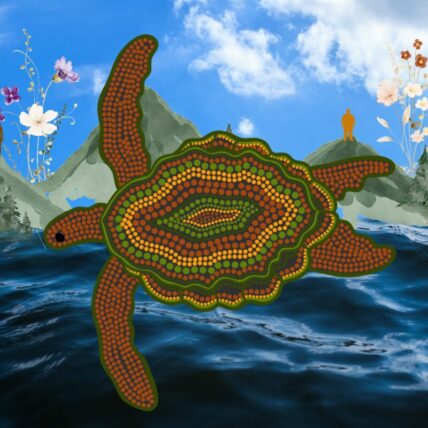
In the timeplace that is now, always now, we are living in great precarity on mikinaak’s (turtle’s) back. The precarity is old and new. My Anishinaabe ancestors were expelled, starved, and forced onto lands both unfamiliar and untenable for their way of life. Several months ago, I witnessed a car kill a doe on impact while her four fawns scrambled back and forth across the road in a panic that was both primal and heartbreaking. More recently, a number of beloved two- and four-leggeds have transitioned from embodiment to spirit. Across the globe, there are genocides, political invasions, executions, and abductions, and endlessly, recursive acts of violence born of abuse and erasure. This reflection on the precarity of life in no way minimizes its fecundity, its beauty. It is the darkness that makes visible the light.
As one of my teachers, Norma Wong, describes it, we are in an accelerating time of convergence¹, where the collapse of all things feels imminent. For those of us of and from peoples who have survived despite centuries of assault, that precarity or collapse is deep in the marrow of our bones. It can be physically, spiritually, and emotionally overwhelming. And too we know that there is a crack—perhaps even the keratin-rich scutes of turtle’s shell growing alongside of her—and this crack presents the possibility of radical change, one that provides both the healing of the core wounds of America’s past and engendering the nutritive rich soil in which to grow something new: a truly multiracial, interdependent society deeply rooted in reciprocity with mother earth and mutual care for each other, including our water, sky, and land-based kin. There are so many brilliant Afro and Indigenous Futurists—artists, healers, scholars, and culture bearers—who are offering ways forward. What follows is simply another offering, an expression of gratitude to nibi, to the lifegiving water in which mikinaak swims.
The Anishinaabe medicine wheel—like the medicine wheels and 4 directional ceremonial practices of other Indigenous peoples—orients our lives to be lived in deep relationship with aki (mother earth) and her rhythms. Honoring the four directions is both metaphoric and figurative; it is attuning to the rhythms of aki, and it ceremonializes “indigenous temporalities which are emmeshed with the land, reflecting a set of ‘relationships of things to each other.’”²’³
For my people, the Anishinaabe people, people of the Northeast woods and waterways of Turtle Island, we start in the east, the direction of the rising sun, for this is our beginning. Placetime is a living, breathing relative, one that changes the way all living things do. For the Yucatec Maya in Belize, the beginning is another timeplace. They start in the north, the place from which they were forcibly removed after the establishment of the Mexican state. They begin in the direction of their homeland. A friend, who is part of a Midwest-based Kalpulli (or calpulli, a Nahuatl word meaning large house or social unit, part of the Nahua tradition of what is now Mexico) shared that they have been queering their ceremonies, invoking the mischievous elements of creation—coyote or Tezcatlipoca, the trickster god who shapeshifts into numerous animals: coyote, jaguar, monkey, vulture—by changing the order of the directions, beginning in the south, the place of growth and fire.
No culture is static. It too is living, breathing, shifting. Yet for so many of us whose cultures have been violently disrupted, there can be a tendency to hold tightly to traditions and practices reflective of a particular moment in time. I find the life-giving blood of queerness to enliven the possibilities of what our evolving cultural traditions might do and be. Or to say it queerly, what might be possible when we play with the sexual potency of our ceremonial practices. And by sex, I mean the capacity to birth new worlds.
In Anishinaabe Time, Sâkihitowin Awâsis—a Michif Anishinaabe two-spirit water protector, writer, scholar, and spoken word artist from the pine marten clan—reminds us that niizh manidoo (two spirit or queer) animates a spectrum of culturally rooted gender expression embedded in Anishinaabewin (Anishinaabe culture) that supports an understanding of settler colonialism as a structure of temporal processes. That is a means of rigidifying, thus killing, the animacy of time. Awâsis suggests “niizh manidoog (two-spirits) hold part of the theory Indigenous nations need to resist settler colonialism.”⁴
Part of that resistance is to tear ourselves away from exposition and turn toward prayer, an Indigenous technology that connects us to the great mystery, aki and all of her inhabitants, and the cyclical nature of time.
This prayer is drawn from the teachings of Lillian Pitawanakwat, an Ojibwe elder from the Birch Island First Nation in what is now Canada, and from my ancestors who whisper prayers to me in my dreams.
We give thanks to the East, waabanong, to springtime, to the spring of life. where our journey begins, where dawn begins, this first breath into the physical world. Thank you, great spirit, gichi manidou, for this gift of birth. As sovereign beings, we honor the sovereignty of all. This gift of sovereignty guides us on our journey.
We give thanks to the South, zhaawanong, to summer where the trees dance, and all life is nourished and thriving. Thank you, great spirit, gichi manidou, for the gift of growth, and thank you, grandmother cedar, for your cleansing medicine, which takes from us what we no longer need to carry. It is in the nourishment and vitality of zhaawanong that our liberation is most palpable.
We give thanks to the West, ningaabii’anong, to fall, to harvest, to the setting sun, this marker of the end of the day, the inevitable end to our lives, this understanding that all life leaves the physical and moves back to the spirit world. Miigwech, great spirit, gichi manidou, for the gift of adulthood and the medicine of sage, which we use to smudge ourselves and clear our minds and hearts so that we may return what is needed, return nutrients back into the soil. It is here, with the medicine of the west, in gratitude and accountability, that we support land rematriation, returning the land to its original stewards.
We give thanks to the North, giiwedin, to winter, to the time of rest and reflection, to the place of our elders and their wisdom, to our ceremonies. Miigwech, great spirit, gichi manidou, for the gift of endings, for the gift of the spirit world to which we all return, and for the knowledge that all endings create the possibility of new beginnings. In this place of rest and return, we are able to repair and support necessary reparations for current and ancestral harms.
In the recursive loops of time, past and future are mere inches apart. And the present, its offering, is the opportunity to attend to the unhealed wounds of this country’s past so that the cyclical body of time will yield nutritive fruit. This understanding of time and our responsibility to all of sentience in this timeplace is reflected in the Anishanaabemowin word indaanikoobijigan, meaning great-grandparent, great-grandchild. The grandchild is the grandparent, and the grandparent is the grandchild. Art critic, academic, and researcher, Tyson Yunkaporta, of the Apalech clan in Queensland, Australia, addresses this Indigenous understanding of ancestral relationship and human responsibility when he writes:
There are three arcs (or petals, as I now think of them) around the center circle that show the way our social system is mapped onto the creation pattern, with three generations of strong women around every child—sisters/cousins, mothers/aunties, and grannies. The grannie’s mother goes back to the center and becomes the child, and all of them cycle through those roles forever, the spirit of the child being born back through the land. Each one also occupies all of the roles simultaneously—so the sister is also someone else’s auntie, and grandmother to her niece’s daughter.⁵
In Western notions of linear time, this makes no sense. But Western constructs have made monstrous what is, in fact, magnificent. We are inextricably connected to everything and everyone. And thus our responsibility—and associated accountability—to live in right relationship is clear. If we are to create the conditions for a generative and healthy future rooted in care and reciprocity, we need to support liberation, land rematriation, sovereignty—both relative to Indian tribes but also the sovereignty of all beings, including water, land and sky—and reparations for the descendants of formerly enslaved peoples as well as other communities who have been robbed of agency, life and material resources.
The Anishinaabe medicine wheel can serve as both a symbol of the interconnectedness of and the acts of repair necessary to Black, Native, and Afro-Indigenous peoples, as well as a ceremonial approach for the ways in which gichi manidou (great spirit) and aki (mother earth) can help guide us in that process. As Awâsis shares in Anishinaabe Time, this act of queering the medicine wheel may hold some of the necessary wisdom to heal the core wounds of America’s past while giving rise to nutritive rich soil in which something beautiful anew can bloom.
Chi Miigwech
This offering draws from more than the Anishinaabe medicine wheel, it draws from deep relationship and practice with aki, my ancestors, my many teachers, and my friends and collaborators—including Ámate Perez, founder and director of the Latinx Racial Equity Project and Decolonizing Race and Elissa Sloan Perry, Director of Prefiguring Futures at Change Elemental. It also draws on the many years of work with the Change Elemental team, specifically around In Strategy & Spirit: Planting the Seeds of a Future We Want.
¹ Wong, Norma Kawelokü, When No Thing Works: A Zen and Indigenous Perspective on Resilience, Shared Purpose, and Leadership in the Timeplace of Collapse. North Atlantic Books: 2024. Pg. 24.
² Deloria, V.J. 2001. Power and place equal personality. In Deloria, V.J. and D. Wildcat (eds.). Power and place: Indian education in America. Golden, CO: Fulcrum Publishing. pg. 23
⁴ IBID
⁵ Yunkaporta, Tyson. Sand Talk. Harper One. 2020. Pg. 40